Compliant
Every requirement is mapped, addressed, and reviewable.
Proposal managers, DDQ owners, security reviewers, sales engineers, and SMEs see the owner, source, and status behind each response.
AI Proposal Automation
Proposal automationTribble reads the requirements, pulls the right deal and company context, drafts tailored responses, applies source evidence, and routes exceptions so proposal teams spend less time assembling answers and more time sharpening the story that wins.
Built for response teams that need buyer strategy, source evidence, confidence, and expert review on every response.
Response teams using Tribble include






Rated on G2
RFP, DDQ, and security questionnaire teams rate Tribble on G2. See 143 reviews, a 4.8/5 rating, and Spring 2026 recognition for implementation, usability, ROI, and recommendation.



Drafting
Buyer-ready drafts
Review
Exceptions routed to owners
Expert Time
Only exceptions routed
Output
Strategy, proof, and export context
From questionnaire to response strategy
Instead of searching a library and pasting old answers, Tribble finds current, relevant knowledge - policies, past wins, CRM context, call insights, approved claims, and reviewer decisions - then drafts a response around the buyer's requirements. Every claim shows where it came from. Uncertain claims route to the expert who owns them. Every won proposal feeds the shared knowledge graph, making the next sales call, knowledge base answer, and future proposal stronger.
Response quality, not just response speed
Tribble handles the full response motion - mapping requirements, shaping drafts around buyer priorities, grounding claims in approved proof, routing exceptions, and preserving what worked - while each buyer workflow keeps its own evidence bar and operating model.
Compliant
Proposal managers, DDQ owners, security reviewers, sales engineers, and SMEs see the owner, source, and status behind each response.
Tailored
RFPs, DDQs, security forms, policies, past responses, product docs, CRM context, and call insights feed the draft.
Differentiated
Teams get parsed questions, tailored responses, citations, confidence context, SME routing, and export-ready work.
Supported
The same response engine adapts to RFPs, DDQs, security questionnaires, RFIs, and proactive proposals without forcing every team into one generic process.
Five response types, one workflow
Proposal automation is not one workflow. It is five distinct response motions, each with different timelines, stakeholders, and evidence requirements.
Full RFP response
Upload the Excel or Word doc. Tribble maps every question, drafts answers from past wins and current policies, flags 15% that need expert review, and routes each to the right SME with deadline context. First-pass draft in hours, not days.
Security questionnaire
Security questionnaires demand specific policy citations. The engine pulls from your SOC 2 report, security policies, and prior approved responses. Each answer shows the exact document section and last review date. Compliance reviewers verify instead of draft.
DDQ for investor diligence
The engine reuses approved answers across ODD, investor diligence, and fund-level questionnaires, updating only what changed since the last filing.
Quick-turn RFI
The engine identifies questions it can answer at 90%+ confidence from approved sources, drafts the full response, and exports. Proposal manager reviews and ships in under 2 hours.
Proactive proposal
AE asks for a tailored proposal deck based on discovery call notes, competitive positioning, and the buyer's stated requirements. The engine pulls relevant case studies, product answers, and pricing context from the knowledge graph into a draft the AE can customize.
AI Proposal Automation is one of three capabilities on the Tribble platform. Every won response becomes governed knowledge that sharpens sales conversations and future proposals through the shared graph.
See how all three capabilities compoundDraft, review, submit
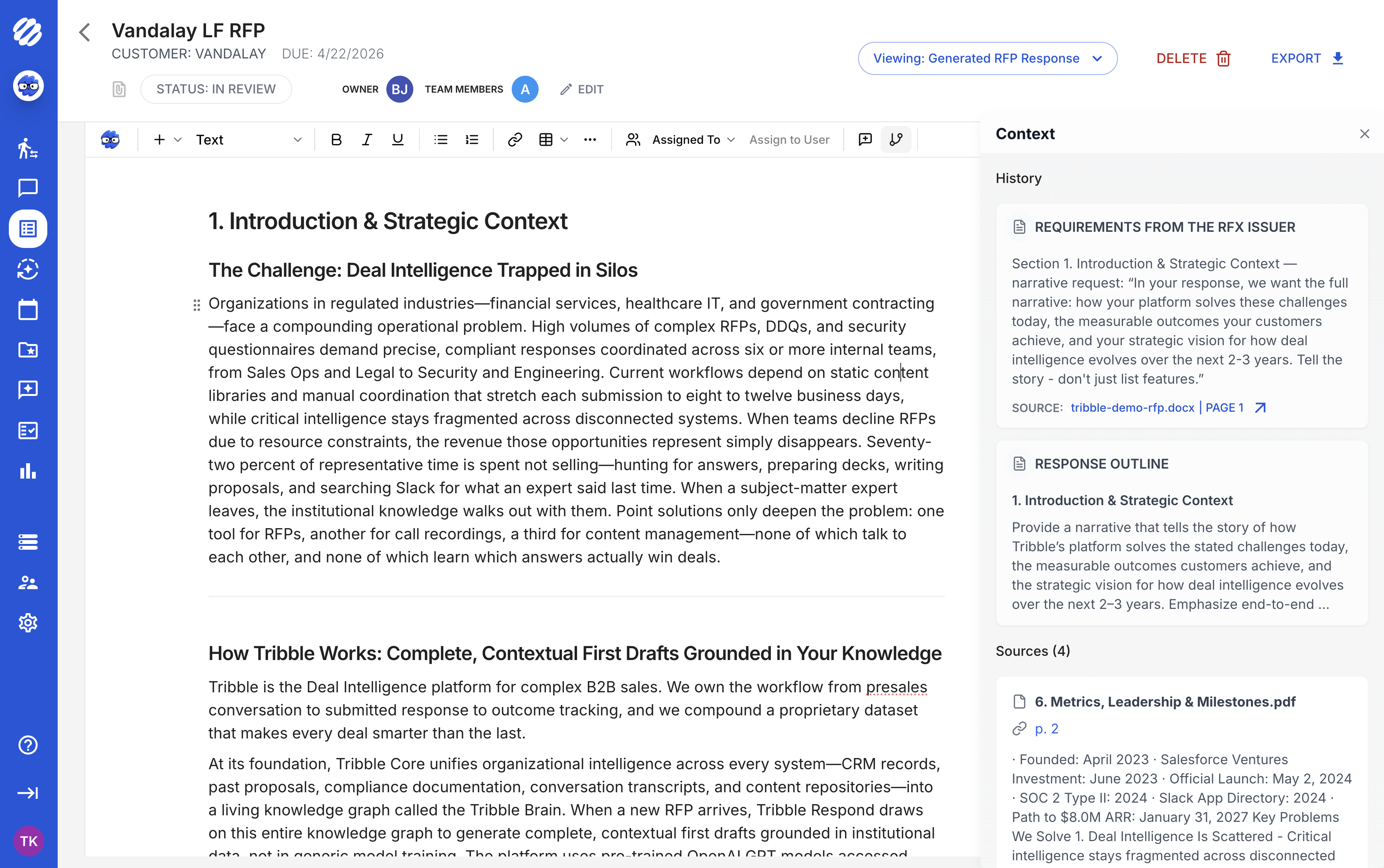
Upload the document, map the questions, draft with evidence, route exceptions, and export in the buyer's format.
01
Drop an RFP, DDQ, security questionnaire, or RFI. Excel, Word, PDF, or portal export. Tribble maps the questions automatically.
02
Each response reflects buyer context, approved proof, and confidence context. Your team sees the evidence before they approve.
03
Low-confidence or sensitive answers route to the right SME via Slack or Teams. Routine answers pass through with source verification.
04
Export in the buyer's format. Win/loss outcomes feed back into the system so future responses get stronger with every cycle.
"I need the response to match the buyer, prove the claim, and show the right reviewer before it leaves the company."
What response owners are really asking forWhy Teams Switch
Legacy proposal tools ask you to maintain a content library and hope the answers stay current. Tribble generates response work from living knowledge, including policies, past wins, CRM context, call insights, approved claims, and reviewer decisions, so responses improve instead of going stale.
Switching from Loopio, Responsive, or Qorus? Import your content library and connect it to the sources that keep answers current.
Explore by response type
The core automation handles mapping, drafting, source context, exception routing, and export. Each response type keeps its own buyer language, evidence bar, and operating model.
RFP Automation
For proposal teams drowning in volume, tight deadlines, and SME bottlenecks. Upload the RFP, get sourced drafts, route the exceptions.
DDQ Automation
For financial services teams handling DDQs, ODD, investor requests, and repeat due diligence packs on tight timelines.
Security Questionnaires
For teams clearing SOC 2, ISO, HIPAA, and enterprise procurement reviews that block revenue.
Audit trail included
For regulated teams, a fast answer is worthless if you cannot prove where it came from, who approved it, and whether the source is still current. Tribble's proposal automation runs on the same governed platform as the Knowledge Base and Sales Agent.
Calculate your ROI
Estimate the hours and dollars trapped in questionnaire volume, answer drafting, SME review, formatting, and rework.
Improves with every submission
When a rep learns something on a call, it strengthens the next draft. When a proposal wins, that answer becomes trusted knowledge for the next deal.
AI Knowledge Base
Proposals source answers from the same governed knowledge your sales and security teams use daily.
AI Sales Agent
Competitive objections, buyer requirements, and deal context from sales conversations make proposals more relevant.
Deal intelligence
Outcome tracking at the answer level shows which content wins and where the knowledge needs updating.
Built for regulated review
Regulated industries need more than fast drafts. They need audit trails, source verification, and answers that match the language their reviewers expect.


Financial Services
For asset managers, banking teams, and fintechs where one wrong answer in a DDQ can kill an allocation.
Healthcare
For teams selling into health systems where clinical, privacy, and procurement language must be precise.
Enterprise Tech
For SaaS companies clearing SOC 2, ISO, and vendor security assessments at enterprise scale.
Where teams start
Proposal automation can begin with one high-volume response motion, then expand into the knowledge base and sales agent as the same approved answers become useful before and after the questionnaire.
Build the proposal case
Choose the right platform
Compare the tools proposal teams use for drafting, review, source control, and response operations.
Modernize RFPs
See how sourced drafting, SME routing, and answer reuse change enterprise RFP work.
Estimate savings
Model your team's volume, turnaround, and rework rate to see what faster drafting can recover.
Customer story
See how a healthcare AI team used sourced answers and review-first workflows to move security assessments faster.
Before rollout
No. Tribble generates new answers grounded in your current sources. It uses past wins as context, not as a clipboard. If a policy was updated last week, your next proposal reflects that. automatically.
Every answer has a confidence score. Low-confidence answers are flagged and routed to the right SME before they reach the buyer. Your team always has final approval. Nothing goes out without a human sign-off.
Implementation depends on your source systems, content quality, review workflow, and questionnaire formats. Existing content libraries can become part of the knowledge foundation.
Yes. Expert review requests arrive in Slack or Microsoft Teams with the question, draft answer, sources, and deadline. SMEs approve, edit, or escalate without switching tools.
See it on your RFPs
Walk through how Tribble connects deal context, approved claims, source evidence, confidence context, and expert review for the workflows your team handles.
Bring your next RFP